
“The truth is we see nothing. Nothing precise. Nothing definitive. We must continually accommodate our gaze”. Gregorie Bouiller. Le Syndrome de l’Orangerie, 2024.
It is indeed the uncertainty that prints our current lives. The idea that we may control the political stage as influencers through social media and voters within a democratic system is far from reality to the point that the true agenda with global ambition for centralised power has been managed for decades, completely out of our sight. However, the official message is that we are part of the processes, and we are “specifically adopting” technology and new habits as part of our “natural progress”. Without mentioning that commercial purposes are at the very priority for whom we are transforming into individuals that are “in” or “out” of the system. A radical change, mainly because of the latest alternative ways of living, is not accepted; not surprisingly, there is a strong movement against taking clear steps towards conservative positions. Schools are removing tech from classrooms, more activities in the open air, and a deep sense of losing values that leads to isolation and a war agenda. As Pres. Italy Giorgia Meloni mentioned “they are recruiting children who stand out for video games and transform them into virtual soldiers that murder as if it were a game.
This is the dark side of AI evolution and technology in general: the use that the owners of their development make rather than the individual does . It raises many questions. For those of us who still believe in faith, creativity, human contact, emotional intelligence, and the capacity to transform humans into resilient souls of progress and evolution, technology is simply a tool, not a way to replace humans with robots and lose hope in humanity. However, this is precisely what is happening, and we may present two examples that expose the truth:
One comes from the hologram AILex created by Alicia Framis, a Catalan woman who believes it is the best way to fight back loneliness, as a therapeutic tool. “Love and sex with robots and holograms are an inevitable reality. They are great companions and capable of expressing empathy,” she pointed out.[1]
The other example is from AI-Da[2] an artist robot that can draw and paint using cameras in her eyes, her robotic arm, and AI algorithms. Challenging the very essence of what art means and pushing into a competition between humans and robots. With the correct programme it may displace the work of human artists and sell -as it happened two years ago- in Sotheby’s a portrait for over S 1 million, marking a milestone in AI-generated work[3]
The challenges are out there when the expectation is to move towards democratic and human leadership. The latest reflects the level of conflict that we faced when analysing and searching for effective, transparent, and accountable political leadership. The fact that Albania has recently appointed “Diella”, an AI creation, as Minister of State for AI to enhance public services and reduce corruption exposes the fact that the political agenda is much more complex than just introducing technology for easing tasks; it is truly a way to give up on humans as ethical and powerful sources of change. The idea that corruption may only be reduced by introducing technology in the form of humans marks a milestone in transhumanism, and not in human development. If the conclusion is that transparency and accountability is not possible with humans, It is equally important to consider that the Minister Diella is managing by humans[4] witch leave serious doubts about Albania´s PM statements that will become “a country where public tenders are 100% free of corruption” “not only we wipe out every potential influence on public biddings we will also make the process much faster, much more efficient and totally accountable”.
Besides, there is no legal framework to support this kind of public representative, which means that democracy is under threat, therefore the Rule of Law. Any attempt to move away from the Constitution and citizens’ decisions would be a close step to dangerous global and centralised power. It is about being led by an elite of humans transforming robots into tools for managing the political system. In conclusion, challenging the very own concept of good governance, therefore SDG 16 Peace, Justice and strong institutions.
The intentionality to move towards transhumanism is determined, as the granted citizenship by Saudi Arabia to the robot named “Sophia” [5]made by a material called “Frubber” that looks and feels like real skin, as well as her face with dozens of tiny motors that control her expressions. A whole system not precisely about assisting humans, but about interacting as if it were humans. Challenging the very concept of inclusiveness.
Leading into a new dimension for the SDG 5 gender equality, as it is now unfolded, the real goal is not precisely about reaching new standards of stability, but the building of a new society where robots are equal to humans, a true new gender. Meanwhile, predictions estimated that the equality gap may only be achieved in more than 300 years. One of the most relevant reasons is the rapid introduction of generative IA that is replacing women´s jobs and eliminating potential jobs in the future at a 29% risk compared to 16% of men´s, according to ILO (International Labour Organisation)[6] “The reasons are structural. Women are heavily concentrated in clerical, administrative and business support roles — secretaries, receptionists, payroll clerks, accounting assistants — where tasks are routine and easier to automate. Men, by contrast, dominate construction, manufacturing and manual trades, where physical tasks are far harder for AI to replicate. At the same time, women make up only around 30% of the global AI workforce, barely changed from 2016, leaving them underrepresented in the very sector that stands to gain most from the technology”
Another global standard that is under threat under the current aim for polarisation is SDG 4: Quality Education. The massive use of social media and media without direction, guidance, or verified information not only impacts the quality of information but also undermines a basic pillar for quality education and judgement: critical thinking. Once Media becomes more important than facts, when official messages from pseudo-global leaders are higher than any other analysis, when European institutions are furthering a war without limits because of financial interests in Ukraine, when the citizens are not part of the decision-making processes, is when finally, we get into ignorance and detachment from ideologies. To the point that when we try to get the political message, we identify clearly that there is only one under the name of “realpolitik”; the truth is that, is not about cancelling ideologies, just focusing on facts, out of judgement. However, it is steadily manipulating to avoid critical thinking. Creating a true ideology around it and punishing anyone who is against it by the threat of being censored on social media because of “politically incorrectness”. Anyone who dares to become politically incorrect, which basically means presenting an interpretation of the current political circumstances from their religious or political view, is literally out of the debate -in case there is any-. Getting into a stage where the citizens seem to be the queen in a perverse chess game that is already played. This is the fake power that social media delivers to individuals, and because of a progressive agenda of literally erasing ideologies. A manipulated concept of globalisation aims to achieve only one global standard that, instead of integrating societies, results in polarisation and more confrontation; in exchange, they offer the “protection” of global coordination that turns out to be dictatorial and moves fast towards empathetic AI, creating even more domination.
Bad time for intellectuals…
In the recently released Encyclical Magnifica Humanitas, Pope Leo XIV invites us to “disarm AI” as a weapon that may destroy human well-being based on the principles of the Social Doctrine of the Church: social justice, solidarity, human dignity, and the common good. Many may associate with Marxist theories; however, it is strictly a religious perspective based on Jesus´ teachings. However, it is conceived as an ideologically left-wing position, which it is not. Is it part of an agenda to polarize that it is sadly out of our control, and the lenses through which any leader is judged -even religious- are based precisely on a biased agenda.Cancelling religion and polarising led to confusion on ideological terms, therefore on accurate interpretation. Reducing the debate to two sides instead of multiple political sides undermines the possibility for a multilateral view and distributed power. Is repeatedly said that is “dangerous” that a multi-polar world represents chaos, but it is not necessarily like that if Diplomacy play a role within the correct leaders.In the historical confrontation between Russia and the USA, the EU dared to play the catalyst and delivered global stability, working as a vaseline process for Diplomacy and negotiation, not as now that is fuelling the conflict and becoming part. We need more neutrality and impartiality to really make an impact and contribute positively, same as the Red Cross´principles.
Cultural and religious differences may find their way within a global commercial status quo, not in geopolitical terms, where it becomes a threat that leads to war. BRICS doesn’t come to bring more pressure but to find a counterbalance. The expectation that China or Russia would follow current standards on political correctness for the sake of globalization is not realistic and leads to more confrontation and violence, because it is not just about economic power, but diverse interests, in many cases, obscure and elitist.
I do believe that zero leadership is the key concept for overcoming the polarisation for our personal and societal development. Recycling from the current standards and official speech, dare to become politically incorrect, and advocate for openness and flexibility. Same as we have zero debate, zero meditation, zero waste, zero training, zero environmental impact, we also need to implement zero leadership and export this concept of reducing our efforts and resources to maximize sustainable production. Originating from a new paradigm of accelerated, yet effective living, the “zero” concept may be the solution for the current leadership crisis.
Indeed, the cascading crises impacting the world are a clear indicator that effective leadership is failing miserably, especially regarding global leadership, so attractive at first, but which, with the accelerated introduction of AI, is becoming useless and dangerous. Reduced to a theoretical set of standards, the global system is not yielding results in the short and medium term. The agenda is based on replacing humans, which is already having a negative impact, for instance, on equity, as women’s participation in the labour market has declined sharply since 2020, due to the elimination of positions potentially for women.
Zero leadership is the revolutionary path to empowering society when institutions fail to achieve stability and the much-desired regional, and therefore global, peace. It channels the power of society within citizens united by alliances that transcend institutions and the political game from partisan interests, connecting the global and the local without conflict. It entails simple leaders who facilitate processes, are 100% accountable, transparent, and ultimately focused on concrete results. In this model, the community takes precedence over representatives, leading in an almost direct manner, balancing power, resulting in a “human-cantered approach.” For this, the ability to adapt and explore new leadership concepts is essential.
It moves from a global- centralized leadership to an intercultural one, attentive to individual needs, within a horizontal and balanced power to address the challenges of AI as their own, tailored to their will and no longer based on monopolized standards alien to the realities of each community.
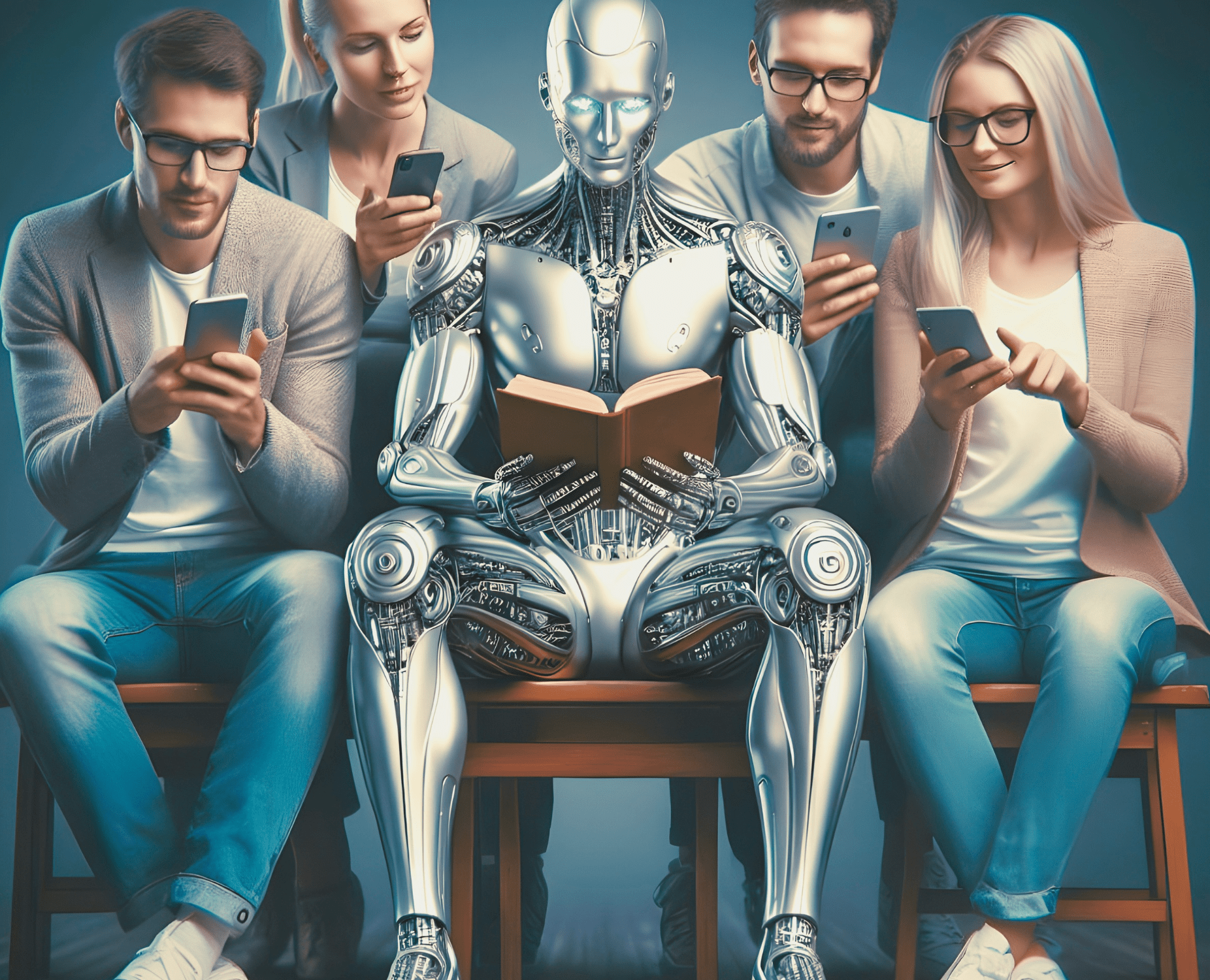
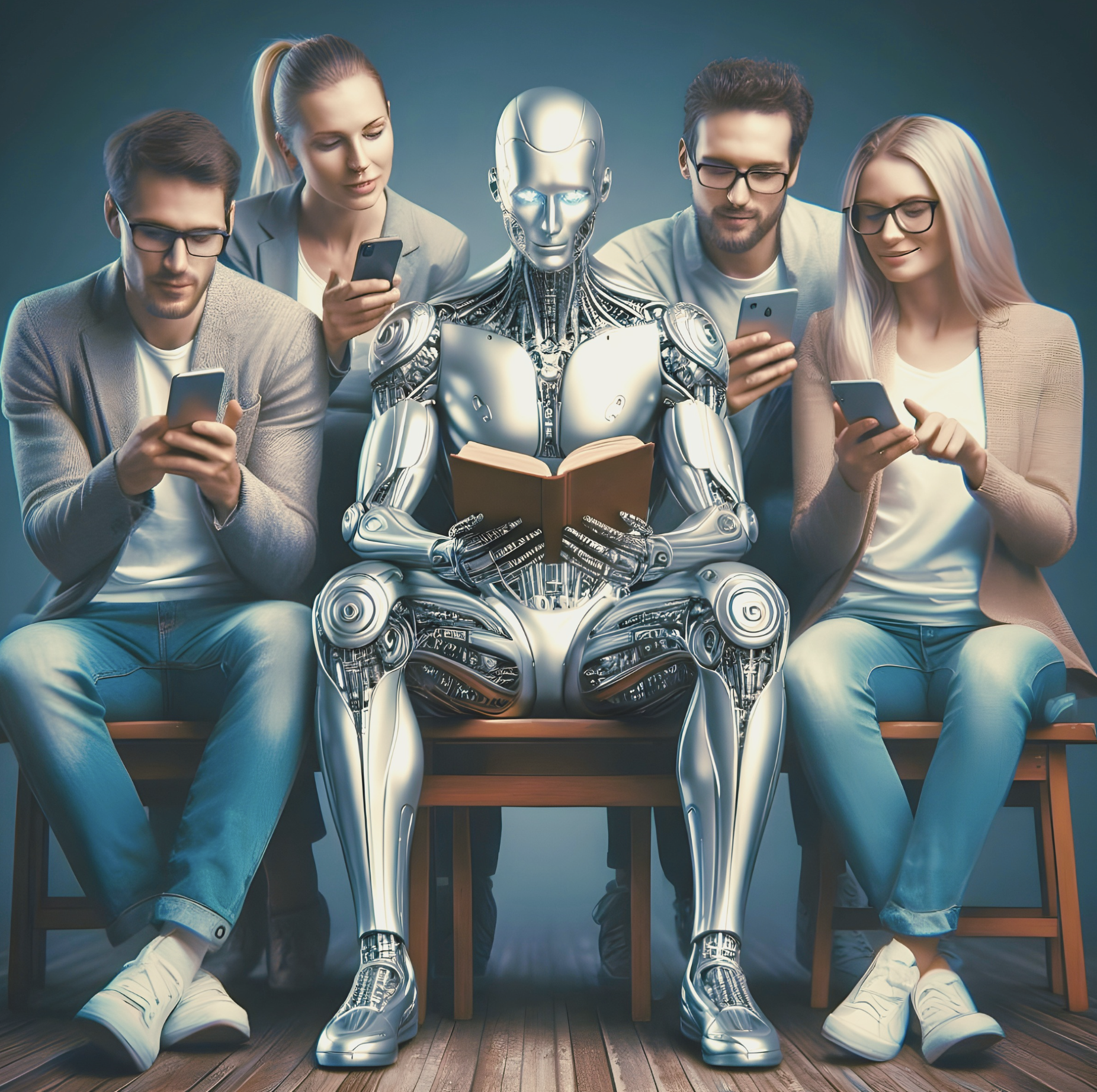
Like the picture generated by AI, a transhumanism agenda aims to change our lenses to the point that humanoid robots become the true intellectuals, while humans continue engaging toxically with their phones, biased information, and fake news despite feeling empowered, while an elite of humans decides the priorities, the criteria for political correctness, or even more, the outrageous cancellation of critical thinking.
All the above may be overcome by implementing zero leadership, where citizens act in a global coordination, interconnected but focused on local issues, by being part of the whole political process. A sort of direct democracy in which SDG´s philosophy is implanted by each religious and political ideology focus. Revolutionary alliances are one of the secrets, not just strategic and institutional, but from citizens to institutions, leaving a trace as actors, not just potential influencers, although within diverse ideological approaches. Connecting global and national without supremacy to avoid conflicts. In the end, inverted hierarchies by transforming the influence of the discredited and traditional political system. Towards a global system that integrates all systems by AI support, and not a centralized power that establishes biased standards that tend to be inefficient, manipulative, and mostly important, cancelling the capacity from humans to awaken their inner creativity and search for new shapes of living based on a values-based approach instead of a tech-cantered system.
Robots 5.0
Humans Zero
Leadership 100%
[1] https://www.euronews.com/culture/2024/01/03/meet-spanish-artist-alicia-framis-the-first-woman-to-marry-a-hologram
[2] https://www.ai-darobot.com/
[3] https://artdogistanbul.com/en/ai-das-alan-turing-portrait-sells-for-1m/
[4] https://www.bbc.com/news/articles/cm2znzgwj3xo
[5] https://www.digitalcitizen.life/who-is-sophia-the-robot-everything-you-need-to-know-about-her/
[6] https://www.developmentaid.org/news-stream/post/205061/ilo-data-show-women-face-higher-workplace-risks-from-generative-ai-than-men-due-to-job-segregation

 thesustainabilityreader
One thought on “Zero Leadership: the lenses to look through AI”