
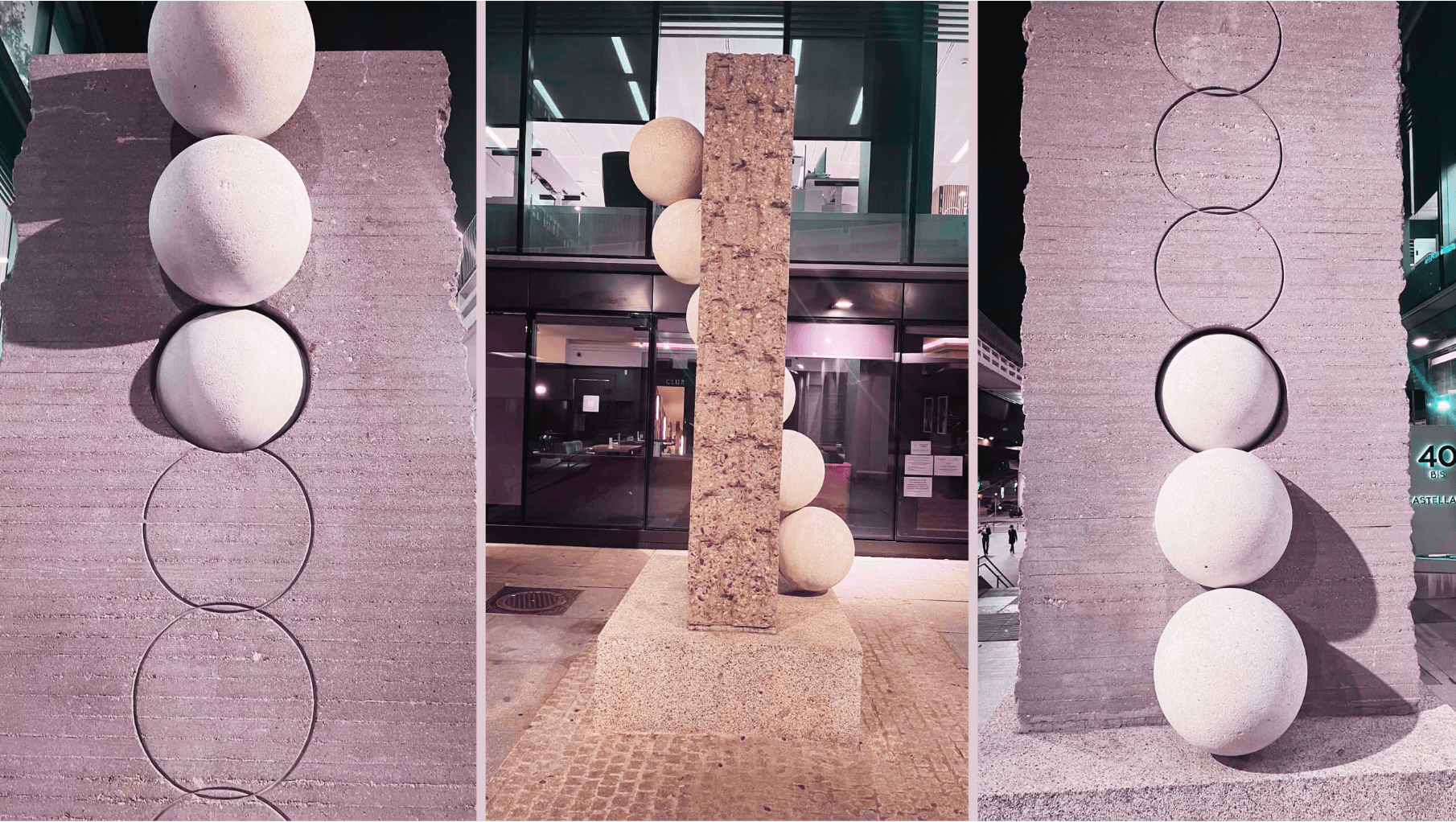
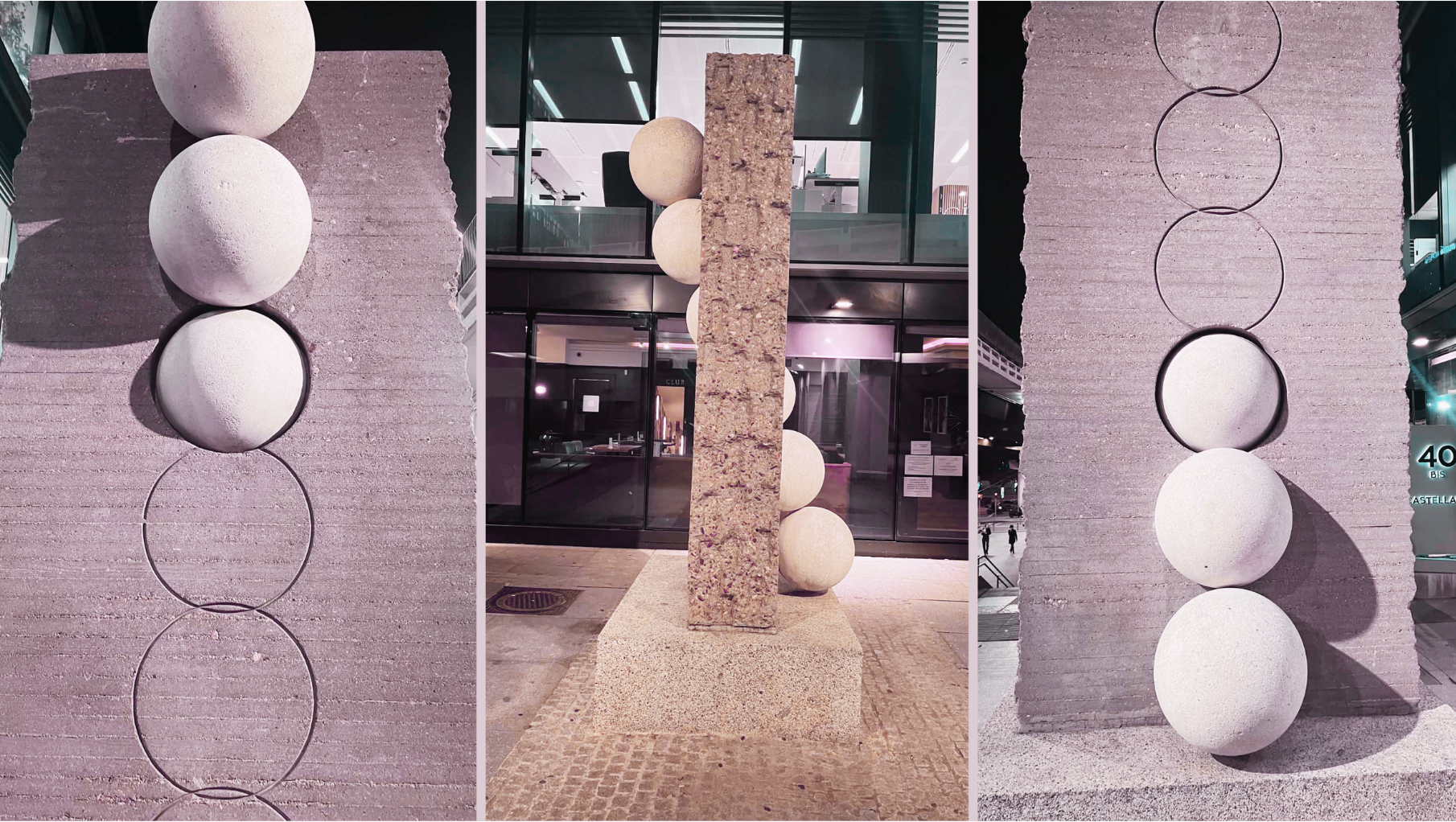
In a radicalised world of “truth” and “lie”, for whom the latest is paradoxically part of the “great truth,” we realise that not all news is reliable, even if the source is so. Rewriting the past -as we are doing now-, including scandals like Epstein files, exposes the cruel truth: not because someone is an influencer does that mean they are reliable. However, we continue to struggle to be accepted and included in the public debate by (literally) repeating what the Media or Social Media is saying. A crisis of credibility is symmetrically aligned with an awakening of in-depth, hidden truth. A needed path towards a clean change. It is precisely what the sculpture is suggesting: don’t rely on the 3 balls at the bottom (right photo), don’t rely on the 3 balls at the top (left photo), just look further (centre photo), and wider: 6 perfectly aligned balls that challenge balance. It´s precisely about resilience in the chaos: keeping the balance even if the environment that surrounds you does not look like it. The sculpture invites us to reflect on the need to have a close look at each situation. Taking distance, appreciating the differences, and rejecting any attempt to believe based on the very first impression.
In fact, only when you look from a creative and critical-thinking position, do you get the whole picture from the global system, completely different from the traditional debates on the so-called dichotomy “globalist-non-globalist.”
Somehow inspiring is when reading the analysis on this matter by Alex Jones´ theories on global conspiracy*. One of the most controversial authors that assign responsibility just to “globalists”, however forgetting that obscure interests are much further than a simple “globalists- non globalists” game, yet, the fact that some leaders bring to the table a non-globalist agenda, helps to keep the balance among those that makes of pseudo debates on peace and humanitarian aid a resource to implement agendas like the ones unfolded on Epstein´s files.
The globalisation movement brought a sad, good advantage to those aiming to control the planet by standards, not integration, by centralising power, not by opening to diversity in policies, actions, and citizens’ preferences. The paradox is that globalism per se is not wrong in philosophical terms; along with SDGs, they are not mistaken in their essence; however, biased interests have polluted the goal that contributes to global democracy. I do believe globalization is a dreamful movement that helps to build integration, making negotiation and Diplomacy real instruments at the service of prevention. Instead, the creation of a “common enemy” named Iran, Russia, etc., surprisingly becomes “politically correct”. Any attempt to conciliate or validate the process on one side by analysing the very roots of the conflict is considered a “threat against peace”.
Being a pacifist has never been so unpopular. A call for action, to stop the war, to show empathy to military and civilians on both sides of the conflict, is associated with betrayal, hatred, or even a war propagandist. Nothing more absurd and against peace than that: preventing civilians from calling for peace by agreements, conciliation, leading towards the settlement of conflicts. On the contrary, fuelling the anger is popular, and if you are politically correct, you “must” be angry, not for the war victims precisely, but for your peers who believe in facilitation processes and flexible leaders aligned with goals based on negotiation. Another good example is the constant demand for more women on the peace process tables, when they are already present. In the case of Ukraine, Ursula Von der Leyen repeatedly fuels the conflict, without delivering tools that lead to an end. Instead, “ as long as it takes” becomes a “motto” for this woman leader, exposing that peace is not only about more women, but also different women who make sensitivity and common sense, a game-changer. Ironically, this is also a non-politically correct position.
The “fabricated wars” are an example of the perverse model of manipulation that seeks a pseudo “global democracy” that is only a new shape for a global autocracy. Breaking the status quo is what I really find promising and a clue for moving forward in the short term.
Globalisation -not contradictory- is essential to become resilient, uniting Nations, criteria, and projects, thinking together in a giant think-tank of individuals, and civil society is key to grow sustainably and democratically.
Private elites and lobbies are not necessarily wrong in a free market within free will, in fact they are a resource that “glue” societies, and let them evolve within a balanced power, although only if their pursue goals based on democracy, not on tyrannical AI that control population minds, wars that divide even more the public opinion, or a grey speech that do not deliver a change aligned with citizen´s purposes. However, it is precisely the latest element that draws the line of a politically correct message, designed by lobbies and further by the power of AI.
Points for reflection
- Peace based on “fighting the enemy” with harder wars does not lead to peace.
- Inclusiveness, based on furthering “new genders” like robots with human status, does not pursue the goal of better respect and integration of human beings.
- Ethical goals based on “censoring social media” by private businesses will not assure fairness within the system.
- Global leaders and institutions that further “never-ending wars,” such as the European Commission, will hardly take us to a reliable leadership focused on negotiation processes.
- Fear of becoming “politically incorrect” will not bring the needed individual freedom to contribute to a healthy/diverse/reconciliatory/innovative debate.
What is truly wrong is to use a global system as a “weapon” for building a society of threat, fear, and mind manipulation, which makes ignorance and weak mental health an asset. In a sense, killing creativity, offering “easy lives” in exchange, repeating the “official speech”, all of it, becomes a powerful resource to erase any attempt towards critical thinking. Certainly, the positive aspect is that it is “politically correct,” and you buy the feeling of being inserted in the society…easy!
Such an idea supposes that the most endangering political decision leads to global nationalism, even in the name of a global democracy. Erasing national sovereignties,sweeping out traditions, culture, and religion, impacts the final goal of building patience and tolerance; therefore, creative minds are open to new ideas and prepared to build new codes on their own.
Even if it sounds cynical, if an intellectual class may pave the way to peace, we may trust and follow, just as happened in the French Revolution, thanks to intellectual construction, change arose, and finally, power is only about democracy. The current chaos is a sign of weak citizen leadership and a weird distribution of power, beyond a lack of equality, and certainly, political correctness.
There is no such contradiction: “globalists-not globalists” yet “democratic – autocratic power” that truly impacts a future global system. The full integration of citizens with diverse opinions and ideologies within the political decision-making process is key to any sustainable change from the system. An authentic negotiation process of exercising patience towards full integration. The opposite leads to a perverse, centralised system focused on toxic power.
Leveraging values, dimensioning local realities, and building strong links around global solidarity are the pillars on which political correctness relies, instead of creating fear around politically incorrectness, which nowadays has become a luxury reserved only for bold creatures.
Political correctness is not delivering the expected outcomes for a better understanding that contributes to more balanced communities; therefore, is it time to tell the truth, your truth, the ethical truth, although not necessarily the correct one…


